Swimming Pool Educational Videos
Pool School
Everything you need to know about caring for your pool
Owning a pool should feel like a backyard oasis, not a second job. Dave Tollefson, founder of Taylor Made Pools, walks you through your equipment, your water, and your weekly routine in short videos anyone can follow.
Why we built Pool School
Over the years we have handed the keys to a lot of beautiful backyards. And almost every time, the same questions come up a few weeks later. What does this valve do? Why is my pressure climbing? How often should I really be testing the water?
We put Pool School together so you have those answers on hand whenever you need them. No jargon, no upsell, no ninety minute deep dives. Just Dave standing at the equipment pad showing you what everything does and how to keep it running well.
Whether you built with us or not, these are yours to use. That is the kind of company we want to be.
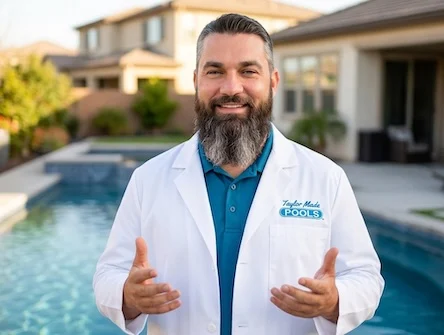
Dave Tollefson Owner, Taylor Made Pools INC.
Welcome to Pool School
Dave introduces the series and lays out what you will learn. Start here if you are new to pool ownership or just want a feel for what is ahead.
[Watch: 2 min]
How to Clean Your Pool Filter and Skimmer
The single most useful habit a pool owner can build. Dave shows you the weekly routine that keeps your water clear and takes strain off your pump.
[Watch: 6 min]
How to Care for Your Pool Vacuum
Your cleaner does the work you would rather not. Keep the hoses, bag, and wear parts in shape and it will keep your floor and walls clean for years.
[Watch: 6 min]
How Your Pool Auto Fill Works
The quiet part of your system that keeps your water at the right level. Dave covers the sounds and behaviors that are normal, and the ones that point to a leak. [Watch: 5 min]
How Your Pool Valves Work
Pool mode, spa mode, spillover, water features. Once you understand the handful of positions that matter, the equipment pad stops being intimidating. [Watch: 7 min]
Understanding Your Pool’s Electrical System
Breakers, GFCIs, bonding, and timers. This one is about knowing your system well enough to spot trouble early and knowing exactly when to call a licensed pro. [Watch: 7 min]
How Your Pool Pump System Works
The pump is the heart of your entire pool. Learn how water travels through your system, what every part on your equipment pad does, and the signs that tell you something needs attention. [Watch: 8 min]
How to Test Your Pool Water
Chlorine, pH, alkalinity, hardness, and stabilizer. What each reading means, how to pull a good sample, and which number to fix first when things drift.
[Watch: 9 min]
The 6 Month Deep Clean Your Pool Filter Needs
Twice a year your filter needs more than a rinse. Dave opens up a large filter and shows you the full teardown, soak, and reassembly.
[Watch: 10 min]
Thinking about a pool of your own?
We build custom pools, spas, water features, BBQ islands, rockscapes, and complete turn key backyards across Southern California, Southern Utah, and Arizona. From mild to wild, we build everything hand in hand with our design and construction team to make your dreams a reality.
F.A.Q.
Common questions from pool owners
How often should I test my pool water?
Test at least once a week during swim season, and more often after heavy use, a big storm, or anytime you add chemicals. In the hotter months across Southern California, Southern Utah, and Arizona, twice a week is a good habit. Sun and heat burn through chlorine faster than most new owners expect.
How often should I clean my filter?
Rinse your cartridges or backwash your system as needed through the season, and plan on a full deep clean about every six months. Your pressure gauge is the best indicator. When the reading climbs noticeably above the pressure you see right after a cleaning, it is time.
How long should I run my pump each day?
Long enough to turn the full volume of your pool over once a day. That number depends on your pool size and your pump, and it usually needs to go up in the heat of summer. Dave covers how to think about run times in the pump video, and if you have a variable speed pump, running longer at a lower speed is typically both quieter and cheaper.
My water level keeps dropping. Do I have a leak?
Not necessarily. Evaporation and splash out account for a surprising amount of water, especially in dry desert heat. If your auto fill is running constantly, or you are losing water noticeably faster than usual, that is worth investigating. Our auto fill video covers how to tell the difference.
My breaker keeps tripping. Can I just reset it?
Reset it once. If it trips again, leave it off and call a licensed electrician. A repeat trip is the safety system doing exactly what it was designed to do, and resetting it over and over is how small problems become dangerous ones. Never open an electrical panel yourself.
What can I handle myself and what should I leave to a pro?
Cleaning baskets, rinsing filters, testing and balancing water, and caring for your vacuum are all well within reach for most owners, and that is most of what Pool School covers. Anything electrical, anything involving opening equipment you are not familiar with, and any repair where you are unsure should go to a licensed professional. When in doubt, give us a call.
Do I need to do anything different in the winter?
In most of our service area pools stay open year round, but run times, chemical demand, and equipment care all shift with the season. Southern Utah and higher elevation areas see real freezing weather, and freeze protection matters there. If you are unsure what your setup needs, reach out and we will walk you through it.
Do you have to have built my pool for me to get help?
No. Pool School is free and open to anyone. If you need service or you are considering a remodel or replaster on a pool we did not build, we are glad to take a look.
What areas do you serve?
We work throughout Southern California, Southern Utah, and Arizona, including Menifee, Riverside, Temecula, Corona, Lake Elsinore, Murrieta, Moreno Valley, Winchester, Fallbrook, San Diego, St. George, Hurricane, Washington, La Verkin, Ivins, Cedar City, Santa Clara, Lake Havasu City, Parker, and Bullhead City.