

Choose a rectangular pool if you want to swim laps, use an automatic safety cover, get a clean modern look, or keep the build simple and predictable. Choose a freeform pool if you want the pool to be the centerpiece of the yard, you have an irregular lot, or you want a softer, natural look with curves, ledges and flowing edges.
Most homeowners fall clearly to one side after answering five questions, which you will find near the end of this guide. First, here is how the two shapes compare.
Freeform vs. Rectangular Pool
| Freeform pool | Rectangular pool | |
|---|---|---|
| Look | Natural, organic, curved edges | Clean, geometric, modern or classic |
| Best for | Entertaining, relaxing, irregular yards | Lap swimming, formal or modern designs |
| Lap swimming | Limited unless a straight lane is designed in | Excellent |
| Typical cost | Usually higher, because of custom layout and more complex forming | Usually lower and easier to price |
| Build complexity | Higher | Lower |
| Automatic safety cover | Possible, but often custom | Simplest and most common fit |
| Fit with home style | Traditional, Mediterranean, natural or desert landscaping | Modern, contemporary, symmetrical architecture |
| Landscape integration | Blends with rockscapes, planters and sloped yards | Frames patios, decks and straight hardscape lines |
What Is A Freeform Pool?
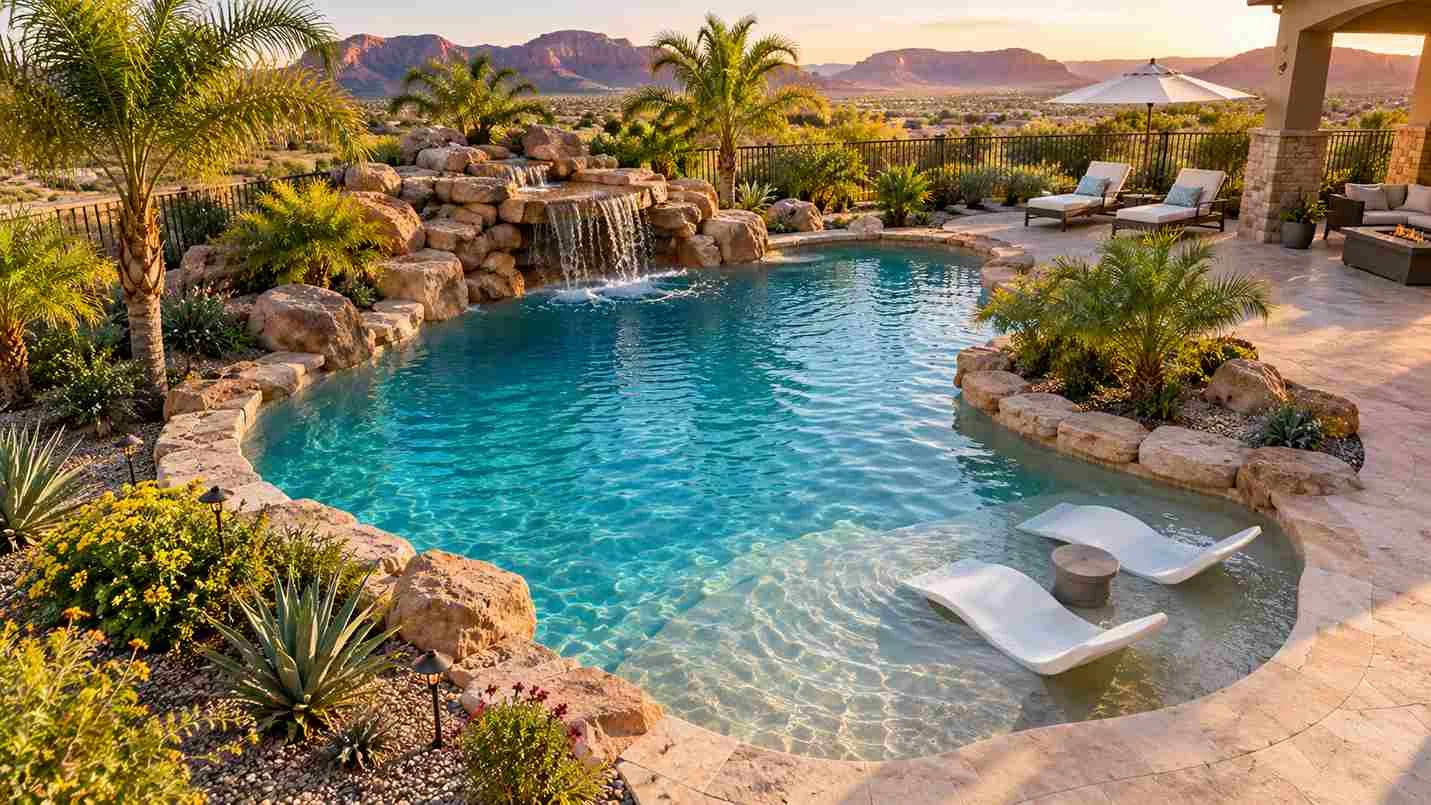
These are designed to conform to the landscaping of your yard. The idea is to blend the pool with your property’s architecture. They give a more natural vibe since nature has curves and imperfect edges, and that’s what free-form pools are.
These are most preferred by homeowners going for a custom look or a homeowner who wants the pool to be a statement piece in the backyard. There are many freeform pool designs to choose from, and homeowners from across the country have provided inspiring examples of their backyard freeform pool designs to help you find the perfect fit.
Popular Freeform Pool Shapes
- Kidney: a gentle, rounded shape with one concave side. A classic and a good fit for mid-size yards.
- Lagoon or natural: irregular curves that mimic a pond, often paired with boulders, a waterfall or a grotto.
- Oval or soft oval: the simplest curved option and a good middle ground between freeform and rectangular.
- Figure-eight: two connected lobes, often a deeper end for swimming and a shallow end for play or lounging.
- L-shaped or wrapped: curves around a patio, outdoor kitchen or corner of the house.
- Custom freeform: a one-of-a-kind outline drawn around your lot, trees, slopes and sight lines.
What Is A Rectangular Pool?
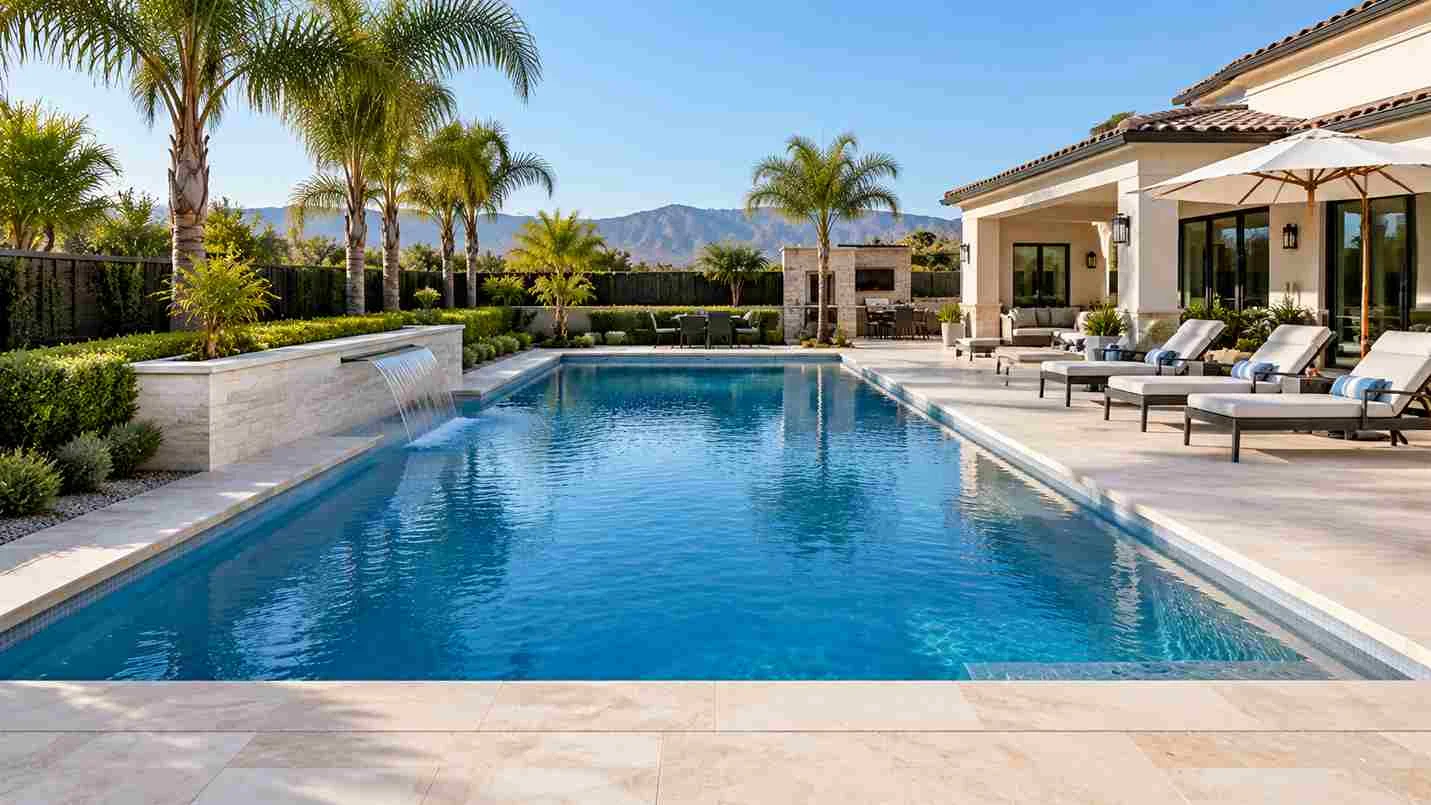
A rectangular pool is the traditional inground shape: four straight sides and square corners. Variations include the classic rectangle, the Roman-end rectangle (with curved ends), the L-shaped geometric pool and the modern lap pool with a long, narrow footprint.
Rectangular pools suit homes with strong straight lines, such as square windows, flat roofs and symmetrical patios, and they pair well with raised spas, sheer-descent water features and tile or stone coping.
How The Two Shapes Compare
Style and curb appeal
Rectangular pools read as clean, intentional and modern. Freeform pools read as relaxed, natural and resort-like. The best match is usually the one that echoes your home: lots of straight lines and right angles point toward rectangular; rounded arches, stone, rock features and natural landscaping point toward freeform.
Cost
Freeform pools generally cost more than rectangular pools of a similar size. Curves require more custom layout, more complex forming and steel work, and more detailed tile and coping cuts. Rectangular pools use straighter, more repeatable construction.
Shape is only one cost driver. Size, depth, finish, equipment, water features, decking, and site conditions such as slope and access often matter as much.
Swimming and how you will use it
If exercise matters, rectangular wins. A straight, uniform lane lets you swim without turning at every few strokes. If the pool is mainly for play, lounging and entertaining, freeform gives you room for tanning ledges, swim-up seating, shallow play areas and a spa.
A freeform pool can include a straight lane for lap swimming if that is designed in from the start. Tell your builder early.
Yard shape and size
Freeform pools handle irregular, sloped or oddly shaped lots well because the outline bends around obstacles. Rectangular pools make efficient use of narrow, long or squarish yards and are easy to line up with a patio or fence.
Safety covers and equipment
Rectangular pools are the simplest fit for automatic safety covers and most off-the-shelf accessories. Covers for freeform pools are possible, but they often need custom fabrication and add cost. If an automatic cover is a priority, say so at the design stage.
Maintenance
With modern circulation design, the day-to-day upkeep of the two shapes is very similar. The difference is in the design: curves and tight lobes can create areas with weaker water flow, so return jets and skimmers should be placed with that in mind. A good builder plans circulation around the shape.
Build time
Rectangular pools generally move through design, permitting and construction on a more predictable schedule. Freeform builds can take longer, depending on how complex the design is. Resale value
Neither shape guarantees a return. A well-built, well-designed pool that fits the home and neighborhood matters more than the outline. Talk to a local real estate agent about what buyers in your area expect.
5 Questions To Help You To Choose
Will you swim laps regularly?
Yes points to rectangular, or a freeform with a dedicated lane.
What does your home look like?
Straight lines point to rectangular. Curves, stone and natural landscaping point toward freeform.
What is the shape of your yard?
Irregular or sloped favors freeform. Narrow and regular favors rectangular.
Do you want an automatic safety cover?
It is simplest on a rectangle.
What is your budget and timeline?
Tighter budgets and deadlines favor rectangular. If you are flexible, freeform gives you more design freedom.
Let Us Help You with Your Pool Building Needs
At Taylor Made Pools, Inc, pool building is our specialty, and our team is happy to work with you to make the process easy and enjoyable. Whether you desire a rectangular or a free-form design, we’ll assess your yard and help you find the perfect pool shape and design for your needs. We want to deliver something that will make you love your pool now and forever.
Contact us to learn more about your pool building options or if you need our services in Menifee, CA.
Taylor Made Pools designs and builds both freeform and rectangular pools across Southern California, Utah and Arizona. Send us your yard dimensions and a few photos, and we will show you how each shape would sit on your property. Get a free quote or call (844) 344-7665.
Frequently Asked Questions
What is a freeform pool?
A freeform pool is an inground pool with a curved, non-geometric shape designed around your yard and style rather than a standard rectangle.
Are freeform pools more expensive than rectangular pools?
Usually yes, for a comparable size, because they need custom layout and more complex construction. Features, finishes and site conditions can change that, so get a quote for both.
Can you swim laps in a freeform pool?
Yes, if a straight lane is designed in. Rectangular pools are still the better choice for serious lap swimming.
Can a freeform pool have a spa, waterfall or tanning ledge?
Yes. Freeform designs are very flexible, and these features are some of the most popular reasons people choose them.
Can you put an automatic cover on a freeform pool?
Often yes, but it usually requires a custom solution and costs more than on a rectangular pool.
Is a freeform or rectangular pool better for a small yard?
It depends on the yard’s shape. Narrow or rectangular yards often suit a rectangular pool. Irregular small yards can suit a freeform shape that wraps around the space.
Which shape adds more value?
Neither guarantees more value. Quality, design and fit with your home and neighborhood matter most.